Site Survey, SOPs & Emergencies
Good operations are planned, not improvised. The CARs require Standard Operating Procedures and a site survey for every flight — Basic or Advanced.
Standard Operating Procedures (SOPs)
Your SOPs must cover Normal procedures, Emergency procedures, and a Site survey, and you must actually use them every time.
- Normal — pre-flight checks, crew briefing, GPS lock, battery levels, lost-comms settings, take-off/landing, post-flight.
Site survey (every flight)
- Remote (before you go): location & coordinates, airspace and rules, distance to airports/heliports, property permission, bystander distance, weather & NOTAMs.
- On-site: actual weather/wind, a safe launch/landing site, alternate landing options, obstacles and wires, EMI sources (metal, towers, powerlines), bystander risk, and the position of the sun (keep it behind you).
Emergencies you must plan for
Your emergency procedures must address: control-station failure, equipment failure, RPA failure, lost link, fly-away, and flight termination.
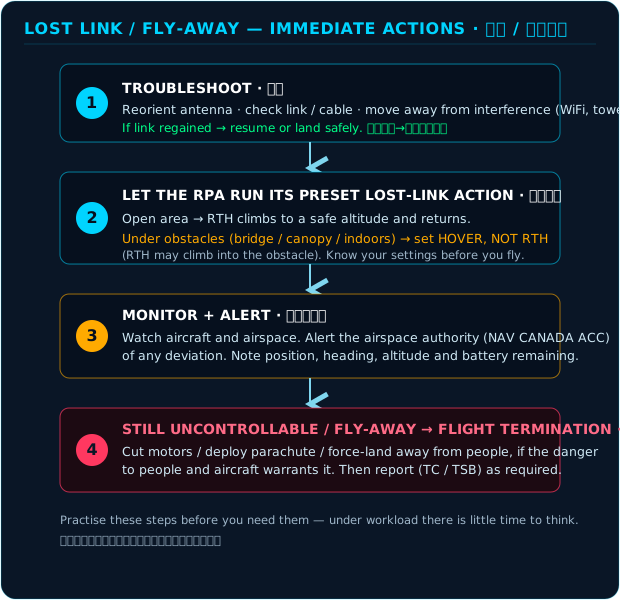
Return-to-Home (RTH) is not always safe. Under a bridge, tree canopy or indoors, RTH may climb into an obstacle — configure the aircraft to HOVER on lost link instead, and know your settings before you launch.
If you can't regain control, alert the airspace authority (NAV CANADA ACC) of the deviation and note the aircraft's position, heading and remaining battery.
Check your understanding
Key takeaways
- SOPs (normal + emergency) and a site survey are required every flight.
- Survey remotely then on-site; find alternate landing sites and EMI sources.
- Plan all six emergency types; hover, don't RTH, under obstacles.
- Lost control → alert ATC/ACC and record the aircraft's state.
Sources: RPAS 101 pp.36–41, 86–91 · CAR 901.23 (SOPs), 901.49 · TP‑15263 §6 (Flight Operations).