Operating Limits & No-Fly Zones
These are the limits that define a Basic operation. Know the numbers cold — most of them are absolute.
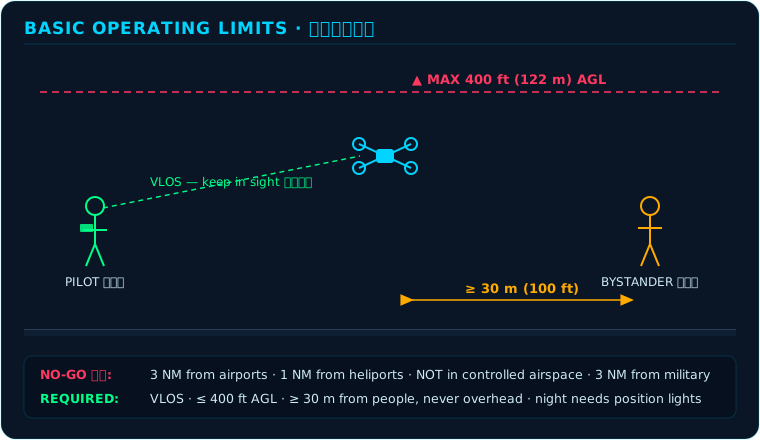
General limits (every RPAS operation)
- Maximum 400 ft (122 m) AGL — exception: within 200 ft laterally of a structure you may go up to 100 ft above that structure.
- Visual line-of-sight (VLOS) at all times — no flying beyond what you can see unaided.
- Night flight is allowed only with position lights.
- Do not exceed the manufacturer's limits (wind, temperature, altitude).
- Stay 3 NM from a military aerodrome (needs an SFOC otherwise) and don't interfere with the traffic pattern at a listed aerodrome.
Extra limits for Basic operations
- Not within 3 NM of an airport.
- Not within 1 NM of a heliport.
- Not in controlled airspace.
- At least 30 m (100 ft) horizontally from bystanders — and never directly over them.
Controlled airspace around an airport can extend well beyond 3 NM. A manufacturer's in-app "geozone" is not the legal boundary — check the NAV Drone app or the NRC Drone Site Selection Tool before you fly.
A bystander is anyone not part of your crew and not protected by a vehicle or building. Briefed crew are not bystanders.
Check your understanding
Key takeaways
- ≤ 400 ft AGL · VLOS · ≥ 30 m from people, never overhead.
- 3 NM from airports · 1 NM from heliports · no controlled airspace (Basic).
- Verify the airspace with an official tool — not the manufacturer's geozones.
- Need to break a limit? That's an Advanced operation (or an SFOC).
Sources: RPAS 101 pp.33–35 · CAR Part IX Subpart 1 (Basic operating rules) · TP‑15263 §1.